Monday, May 14, 2012

Kumamoto: May 1-2

First things first, let’s see this famous castle everyone’s talking about.

Second things second, what are we going to do for the next two hours until our couch surfer host can meet? How about wander around this park in the drizzle? That’s nice. This is really pretty. Ooooh, who’s that other gaijin walking around? I have no idea, he’s cute, though. Maybe we should talk to him . . . oh, he’s gone now. Well, nevermind, then.

OK, now what? Mmmm, let’s try to find an awning to stand under. Good thing you brought that umbrella. The rain is really coming down.

Oh, finally, it’s 7:00! And here’s K now! Hi, nice to meet you. I’m Jaimie. Thanks for letting me stay. Ramen? I’d love ramen! Wow, this is really delicious. This is your place? Very cool. Well, goodnight! Thanks a lot for being a great host. If you ever come to Gunma, let me know. Goodbye . . . !

All right, here it is, 7:30 a.m. and I’m on the most crowded streetcar I’ve ever been on. And it keeps getting more crowded. Don’t knock me over, guy, that’s rude. Seriously, how many people can you fit on this thing?! Finally, Kumamoto Station! And. . . let’s see here . . . 8:23 train to Nantoka-Nishi, then I’ll get a bus to the Mt. Aso volcano, and a cable car to the top. Oh, I'm so excited! I'm really looking forward to seeing the crater and the steaming lake. It’s gonna be so cool!

Are you kidding me? A two-hour train ride and a half-hour bus ride, and I can’t go up to see the volcano? It’s closed?! Off limits? Well I guess I don’t want to inhale toxic fumes and die, but SERIOUSLY? Oh, all right, I’ll go to the Volcano Museum instead.

Whoa! What’s the deal with the animatronic guide?! Creeeeeepy!

Most. Disappointing. Thing. Ever. Even with the “live coverage” of the volcano broadcast into the museum, it’s way too cloudy and misty to see anything. Guess I’ll go sit on this bench in the corner of the omiyage place and wait for the next bus back. It’s way too cold to walk around, anyway, and this horizontal rain is stinging. I thought it was going to be warmer today . . .

Oh, hello, sir. You’re waiting for your bus, too? It’s a shame about the weather, isn’t it? Thank you, I’ve been in Japan two years. Haha, no, my Japanese isn’t good yet; I’m still studying! Oh, you’re from Tokyo? I live in Gunma now. Yes, yes, Kyushu is beautiful; I love it. Oh, it was nice talking to you, too, have a good rest of your trip! What? Seriously? You’ll buy me two boxes of omiyage plus a karai daikon? That’s so nice of you! What a feast! Thank you very much!

What a sweet old man. I love being able to communicate with people, even when my Japanese isn’t all that good. I like this couple over here, too. It's nice that they're talking to me a little bit, too. It’s cool that even though the guy is deaf, we can still talk about how cold it is, how bad it is to have missed the volcano, and how spicy that daikon is.

Well, it's 1:15, time to go back down, huh. Guess I’ll try some of this fried horsemeat before I go. Who knows when I’ll have a chance to eat that again. Mmm, not too bad. Not the best thing I’ve ever had, but not bad either.

All right, back at Kumamoto Station. What do you want to do? You wanna eat here or wait till Kagoshima? Tell ya what. Why don't you try to change your Shinkansen ticket for an earlier one, that way you can get to Kagoshima an hour earlier and eat with Soshi’s parents? Don’t forget to get your stuff out of that locker before you go either. And take your coat off; you don't need it any more. 

All right, now that you’re nicely settled in your comfortable Shinkansen seat, speeding towards the southern tip of Kyushu, what did you really accomplish today? Met two German travelers, a Japanese couple, and a lady from Singapore, got some free omiyage from that nice retired man, ate some horsemeat, and learned about volcanoes, even if I didn’t see one. Not a completely wasted day, I suppose. I sure hope Kagoshima is fun.

Nagasaki: April 30-May 1


(Before my story starts, I’d like to put in a plug for Couchsurfing.org. I used it both in Nagasaki and Kumamoto and met two really cool people. Sign up, host, surf! It’s awesome!)

My flight left Tokyo for Nagasaki at 7:30 a.m. on Monday morning. Having spent an almost-sleepless night in Tokyo the night before (“gotta get up in 6 hours . . . gotta get up in 5 hours . . . “) I was obviously exhausted. But I slept a little on the plane and managed to be fairly coherent by the time I met my previously-arranged tour guide in front of the Atomic Bomb Museum at noon.

I was prepared for the museum to leave me breathless and teary with its stories of massive death and destruction, but unfortunately all I felt was annoyed at the sexagenarian who was accompanying me. She was a kind enough lady, and certainly knew a lot about the subject, but she had a tendency to just read the posted plaques beside the displays without giving much extra information. After she talked, she looked at me pointedly as if she expected some kind of intelligent reply, but all I could do was murmur politely, “That must have been horrible,” over and over again. Her presence ended up being more of a distraction than a help, and I kind of wished the whole time to be left alone so I could immerse myself in the history at my own pace. When it comes to something as monumental as war, I need time to think about it on my own.

We did do one thing that I would never have known about on my own: in a hard-to-find corner of the National Atomic Bomb Museum, she sat me down in front of a computer and said, “You can record a message that will be kept here for the next ten years.” So I had my digital picture taken and penned a hopeful-sounding message to the people of the future. Maybe I’ll return in a few years and look myself up, if the world is still standing.

After the museum, she took me to the atomic bomb hypocenter, the place where the bomb actually exploded. Now it’s a green park with flourishing trees and memorial statues dotting the place. It was sprinkling lightly but with a jacket and umbrella it wasn’t too cold. We strolled around Peace Park as well, admiring the gifts of various statues from around the world. As we walked, we chatted somewhat amicably in English (and surprisingly, in Spanish!), but I could never reach beyond her tour guide personality into what she really thought about things. Maybe that’s what bothered me—that we couldn't have a real conversation. It was just, “Look at this, look at that.”

Three hours after we started (we also saw a cathedral) we said goodbye back at the front door of the museum. For 1,000 yen, I had learned a lot about Nagasaki’s history and the horror of the atomic bomb, but I honestly feel that it would have been a better experience left to my own devices.

Luckily, I had the next 48 hours to be by myself.

***

I’ve only traveled by myself once before, when I was 21 and in Spain for a month and a half. I was supposed to meet a friend in Granada, but she backed out at the last minute, so I went by myself. Even though I ended up meeting some really awesome people at the pension I stayed at, the first night of having dinner by myself in a crowded plaza was unpleasant at best.

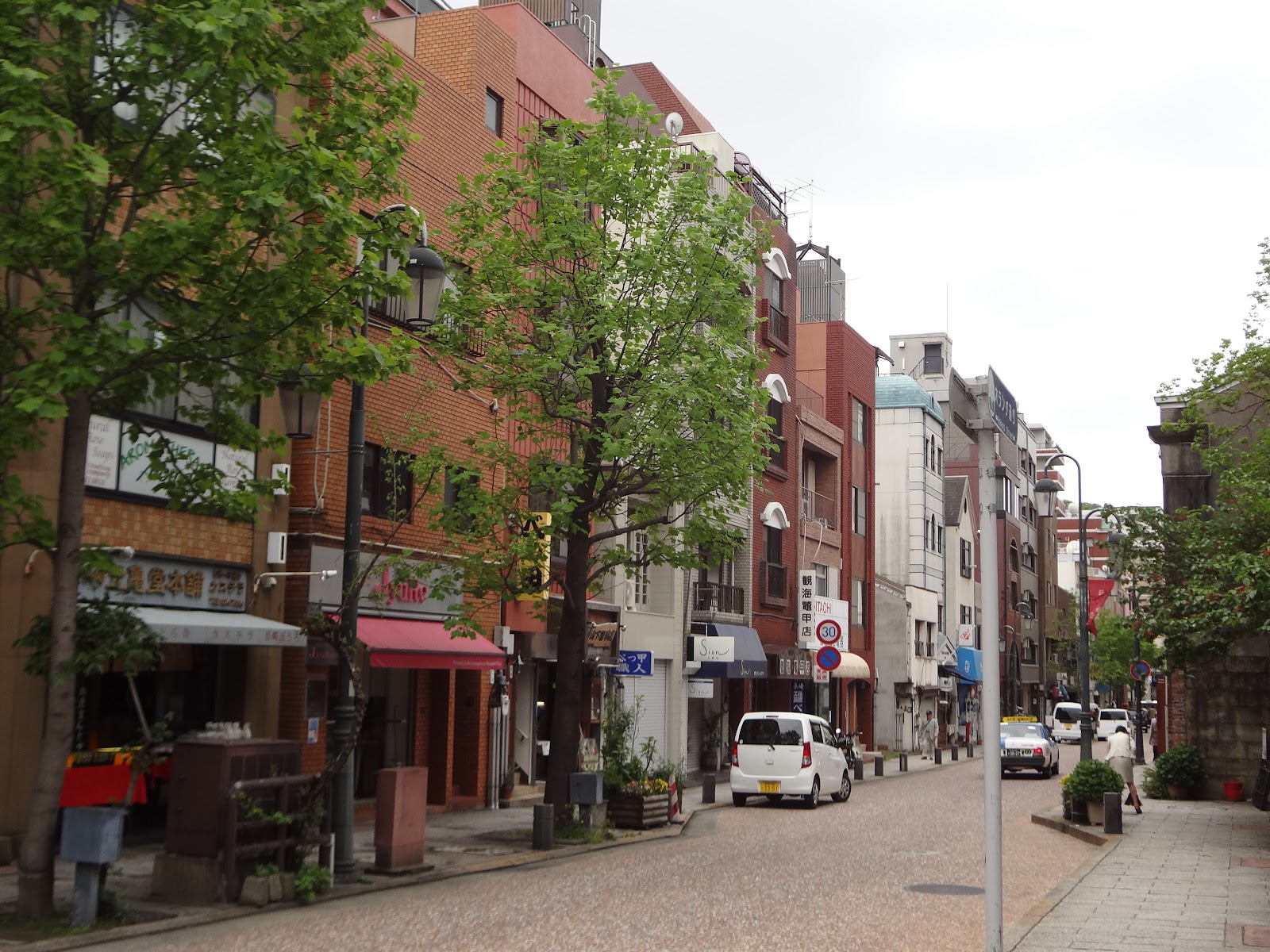
Eight years later, I only felt self-confident and assured as I guided myself around the city. Armed with just a tourist map and my iPhone, my 20-pound backpack and I checked out all the cool things Nagasaki has to offer in a day and a half. Prior to my original belief, this city is NOT just the site of the atomic bombing in World War II. It’s a hip, cool, interesting, city with a history of international immigration. You can walk to many of the tourist sites, or take a tram/streetcar for 120 yen no matter how far you go. So I checked out Dejima (the site of a 17th c. Dutch factory), Hollander Slope (more Dutch), Western-style houses, Glover Garden (home of a famous Scottish man), Chinatown (obvious), several Catholic cathedrals, and, one of the few Japanese things, Temple Row. I also bought a castella pound cake (a Portuguese delicacy) at the oldest shop in town—and ate more than half of it myself.

Just walking down the streets in Nagasaki had such a good feel to them. The city isn’t too big, isn’t too small, it’s just right! And the springtime weather, after the harsh Gunma winter, was a welcome relief. However, time’s a wasting; we've gotta board the bus for Kumamoto.

Tuesday, May 8, 2012

Kyushu Prologue: How I Ended Up In Japan to Begin With


This is the story of a 25-year old American girl who fell hopelessly in love with a Japanese foreign-exchange student from Kagoshima in 2007. She was working on her Master’s in ESL Education; he was studying English at the same university and came to her weekly English conversation group. OK, so she was married and he was completely uninterested in her, but despite the fact that nothing even remotely romantic ever passed between them, he was the reason that she first became interested in the language and culture of Japan.  

She met other Japanese students; they taught her hiragana and katakana and how to say basic greetings in their smoothly flowing language. She started doing a language exchange with a Japanese woman living nearby. And after one new Japanese girlfriend made her a mix CD of popular Japanese music, our heroine listened to Aiko singing “Sakura no Toki” over and over again, straining for the one or two words she could actually understand. As her Master’s graduation grew nearer and nearer, her resolve grew stronger. “I’ll go to Japan,” she promised herself. “I will go teach English in Japan.”

In May 2008, the cute Japanese boy moved to Texas for grad school and was soon in a long-term committed relationship with a pretty Japanese girl he met there. Gradually, he and the American girl who had been hopelessly infatuated with him lost contact with each other. By the time she finally arrived in Japan in 2010, freshly single and with this new language tripping lightly on her tongue, she discovered with something like surprise that she had lost all romantic interest at all in her long-ago idol.

It wasn’t the end, though. Through a series of interconnected events, four years after she said goodbye to him on a bench at their North Carolina university, she found herself in his hometown, hanging out with his parents . . . 

Monday, April 23, 2012

Things Just Aren't What They Used to Be

I was supposed to meet some friends in Takasaki City at 6:30 on Saturday evening; having, however, arrived by chance a little before 4:00, I had a full two hours to spend before it was time to meet. I had pinned one area of the old downtown section "Cool Place" on my iPhone in September 2010 but had allowed 18 months to go by without exploring it fully. Here was my chance.

"Cool Place" might well have been christened "Old Place"; it's a covered section of shops on the northwest side of the station spanning some ten blocks, more than half of which are closed down. The ones that are still in business seem rarely frequented, and their aging proprietors, surely having worked there their whole lives, seem solitary souls.

I started on one end at a dusty china shop. Outside, a table was laid out under the dreary April sky, laden with rice bowls, sake cups, handleless tea cups, and other assorted dishes in piles of 50 yen, 100 yen, and 200 yen sections. Upon entering I was shocked by both the lack of customers and the wealth of wears--teapots, glasses, cups, and plates were precariously balanced on shelves lining up all walls. For all their splendor, though, there was a fine layer of dust over everything and the store had the feeling that no one had cleaned in years.

Even so, I found many pieces that I loved, and set them out on the counter for the chain-smoking tenin to wrap for me. According to the labels affixed on the pieces, I should have ended up paying more than 6000 yen, but he gave me a gigantic discount (without having asked for it). The 2800 yen flowered tea pot that I loved was acquired for only 500; the 800 yen chopsticks were lowered to 200 yen each. He wrapped everything in newspaper, smilingly told me my students were lucky for having such a pretty teacher, and sent me on my way.

I wandered up and down the street of other shops, stopping at a stationary store and a sweets shop, imagining life in Japan back when these stores were up and bustling. Surely in the 60s and 70s this area was the place to go--first to the vegetable shop, then the meat shop, on to buy books at the honyasan, a hat at the hat store; each shop dedicated to one purpose and surely having the best quality for it. Now, walking this line of half-closed down stores filled me with such nostalgia for a world I never knew, I almost felt like crying for its loss. I hadn't meant to buy anything that day, but sensing the hopelessness of decaying businesses, I felt compelled to contribute something to keep them going.

Of course modern life is convenient, but I still get filled with sadness for a life rapidly disappearing. No one wants to go shopping in the old stores downtown; they want to go to the places right around the station, where everything is together, or at the mall, way out of town. Ironic that right after shopping at these mom-and-pop stores I went to Costco. What can you do to preserve the simplicity that once was found here?

It's not just Japan; the U.S. has long since felt the sting of big box stores swiping business away from individual small business owners. Luckily there are downtown revitalization programs sweeping the country as well, but I know it'll never be what it was before I was born. I know the words "progress" and "change"--I just prefer "simple".

(Post Script: I've been reading "Jane Eyre" for the past two weeks; I think my writing is accidentally getting a 19th century feel as a result.)

Tuesday, April 17, 2012

In Defense of Small(ish) Towns


10 Biggest Cities I’ve Been To (And Their Populations)

10.)   Nagoya (3,377,000)
9.)    Washington, D.C. (3,927,000)
8.)    Madrid (4,072,000)
7.)    Toronto (4,657,000)
6.)    Chicago (6,945,000)
5.)    Osaka (8,815,000) 
4.)    Manila (16,300,000)
3.)    New York City (19,750,000)
2.)    Mexico City (20,450,000)
1.)    Tokyo (32,450,000, currently the largest city in the world)

(Population numbers from worldatlas.com)

Big cities have a lot going for them. They’ve got good art, culture, museums, music venues, international establishments, lots of diversity, all the types and variations of all the food you could ever want or think of, fashionable clothes, fun places to shop, entertainment up the wazoo, all kinds of people from hipsters to the homeless, bars, clubs, parks, places to hang out, and more. There are more jobs in the cities, so they're good for the economy. Thus, they are, for the millions and millions of people who live there, the place to be.

But they’re also terribly crowded: crowded trains, crowded streets, crowded restaurants, crowded train stations, and it takes an eternity to get anywhere, either jostling for a space on the jostling train or sitting still in terrible traffic watching the hours flow by. Even so, everyone is in a hurry, rushing from platform to platform, taking the stairs two at a time, never slowing down. Things are expensive in a big city, too, from housing to a vending-machine coffee.

During Spring Break, I spent five days bouncing around Omiya, Tokyo, Nagoya, Yokohama and back to Tokyo, during which I had ample time to dwell on the positives and negatives of living in a big city. After not a lot of reflection, I confirmed what I already knew: for me, it’s a vehement no.

It’s not that I dislike visiting big cities. On the contrary, I love the flash and excitement that comes from visiting a huge place. I’ve seen and done fantastic things in this metropolitan world that I’d never have a chance to do in a smaller location. Plus it’s self-affirming to be armed with just a map of the subway system, a travel guide, and an iPhone to be able to travel around a city. (Although of course I much prefer visiting someone who lives there who can be my guide.) But to live forever in a city of over a million? Never.
  
I suppose it’s all a matter of taste. Where the city is too stressful, too superficial, just too damn big for me, a city under a million is just too dull for others.

Maybe because I grew up on a family farm at the end of a dirt road in rural North Carolina. Maybe because we only had one high school in the whole county. Maybe because I read too much Laura Ingalls Wilder (Little House on the Prairie, anyone?). Maybe because my hobbies run more towards reading under a tree than clubbing in Shinjuku. Whatever the cause, I am able to appreciate the down-to-earth-ness of a medium-sized city more than the glamour and excitement of urban life. I, though world-traveled, sophisticated, and multi-lingual, am no 21st century urbanite. 

Look at small towns in Japan. A chestnut farm, a cabbage farm, a strawberry farm, a local vegetable stand. A dilapidated temple falling down from disrepair. Little restaurants, coffee shops and bakeries that close at 5:00 p.m. but that have the most delicious food you’ll ever eat. A smiling “irashaimase” from the proprietor. A huge blue sky over groves of cherry trees.

Small towns in the U.S. We’re not talking about politics here. There is something lovely about the salt-of-the-earth folk, the countryside diners with fried chicken and okra, the post office, supermarket, bank, farmers’ market people all knowing who you are. Sure, there’s small-town gossip, but that’s better than being invisible. And in a city of 200-400 thousand, you can still get a small-town feel without feeling stifled.  

I don’t need a lot to be satisfied with life, despite my actions which might make some of you think I crave constant change and excitement. [I did move to Japan, after all.] But I discovered way back in high school that it doesn’t really matter where you live as long as you have friends with you. (Thank you, Erin, Jacquie, Phillip, and Walker.) Because where’s the fun of living in Manhattan if you don’t have anyone to hang out with? Why work your ass off every day to pay your exorbitant rent if you don't have anyone to chill with after work?

In terms of the city itself, there are a few things that I find indispensible. I need a good grocery store, a farmer’s market, parks, and a local coffee shop. It would be even better if there were a used bookstore, international independent restaurants and relatively inexpensive yoga classes, too. Then I’d be super happy. But I'd settle for just the first few. I don’t need or desire designer clothes, super hip bars and clubs, or a condo with a skyline view.

I’ve traveled to six countries and lived in three of them. I’ve enjoyed their culture, art, museums, sightseeing places, tourist destinations, food, and shopping. And before I die, I want to go to Buenos Aires, Santiago, London, Paris, Rome, Oslo, and Helsinki. It will be wonderful to see all that those cities have to offer, and I will lap it all up eagerly. But I’ll also be glad at the end of those travels, when I come home to my house in a city I don’t yet know, in a neighborhood I haven’t yet visited, but that surely has copious amounts of trees under which I can sit and read to my heart’s content. 

Wednesday, April 4, 2012

New Teachers and New School Year

Last year, when all was new, I wrote a long post about graduation, going-away ceremonies, new student matriculation ceremonies, new teachers coming in, and all of the huff and fluff that comes with the ending of one school year in March and the beginning of the new school year in April.

Since you've read the same thing already, I won't bore you with the details of this year's changes. I will say that my favorite teacher/supervisor/mentor left my school to go work in the Board of Education, which makes me very sad because we won't be teaching together. We will see each other once or twice every few months when I have B.O.E. meetings, but it's not the same. Most of the new teachers seem cool--again, they're young like last time!

There's a 22- (23?) year old girl who just graduated from college who will teach math, a 29-year old P.E. teacher (married to my old JTE from two years ago--how funny that he works in the same school she did!), and a 28-year old Japanese teacher who sits in front of me and who luckily can speak a little English. My new JTE is a friendly, energetic woman in her 30s; I'm looking forward to working together. There's also an assortment of "older" (40+?) teachers who seems like nice people, in the two days that I've known them.

It's a strange feeling, though, to know that I'm only going to be working here for three and a half more months. It's just enough time to get to know everyone well and become friends before it's time to pack up and move out. I hope my successor enjoys working here as much as I did! It looks like she/he will have a lot of cool people to hang out with at work! It's the teachers as much as the students who make this job so enjoyable; I'm a lucky girl to have had so many nice folk.

Friday, March 23, 2012

End of the School Year


This past week was the last week of school before spring break and the start of the new school year in April. It’s been predictably free for me—ever since 3nensei students graduated on March 13 (leaving a gaping hole in the middle of my heart), I haven’t had much to do besides teach a few “fun” review classes for ichi and ninensei. So to fill up my time when I’m not looking up new recipes or planning my next trips, I’ve been going to other teachers’ classes to watch.

Today I went to an ichinensei Japanese class and a ninensei math class. Both of the teachers are fairly young and have adopted fun teaching practices that I haven’t seen much of in the older teachers. The Japanese teacher brought individual whiteboards and whiteboard markers for the students to use while we discussed grammar in groups, and the math teacher timed us to race to complete the math problems. We worked on dividing and multiplying fractions and doing 3-step problems with mixed numbers. For example:

1/2 + 3/4 ÷ (-2/3)

(It’s -5/8, by the way.)

I missed five out of 40 problem, which I guess isn’t too bad considering I haven’t studied this stuff in 15 years. I was also happy to hear the math teacher say two things I really didn’t expect: 1) It doesn’t matter how you solve the problem, as long as you get to the right answer; and 2) Math isn’t about memorizing; it’s about thinking. Somehow in my head I thought Japanese education was all about playing by the rules and going by the book, so it was pleasantly surprising to see how wrong I was. I still think Japanese teachers work too much – being at school from 7:00 a.m. to 9:00 or 10:00 p.m. every day is just a little extreme – but it’s good to know that they’re still passionate about helping kids learn.

By the way, they’ve made the announcements for next year’s leaving and staying teachers. The three English teachers I work with now are all staying, but my favorite, the kind, helpful head of the English Department who has been here since I first started in August 2010, will leave. The librarian, a first-year math teacher, two of the disciplinarian heads, and the sexy gym teacher who just started last year, are also all leaving. I wonder who will come take their places . . . even though, in the long run, these changes don’t affect me too much personally, although they do affect the ALT who will come after me. After turning 30 on August 2nd, I’ll be returning to the U.S. for good to start all over again.

Or at least until another traveling bug hits me.